The Jones Act, the Farm Bill, and Other Old Laws Quietly Shaping Your Costs
A 1963 proclamation about frozen chicken, a 1920 shipping statute, an 1886 passenger law, and a farm program whose fallback rules date to 1949 - four survivors that still price ordinary American purchases, and the legislative machinery that keeps them alive.
Evergreen explainer, checked against the primary sources listed below. Full disclaimer
On this page6 sections
Walk a U.S. dealership lot and you will notice something that seems like a matter of taste: almost no small pickups. Americans, the story goes, simply prefer big trucks. Some do. But the reason a compact pickup built in Thailand or Argentina is unlikely to be parked next to the full-size ones has less to do with taste than with a document signed on December 4, 1963, in response to a dispute about frozen chicken.
That document is Proclamation 3564. Europe's new common market had raised barriers against American poultry; Washington retaliated by raising duties on four things Europe sold well. Three of them — potato starch, brandy, dextrine — are forgotten. The fourth was "automobile trucks," at 25% ad valorem, effective January 7, 1964. The poultry fight ended. The truck tariff did not. As of 2026 the Harmonized Tariff Schedule still lists a 25% general rate on light trucks and 2.5% on passenger cars, a ten-to-one gap that shapes which vehicles are worth importing, which get assembled domestically, and what a truck costs.
This is not a story about one weird tariff. It's a story about a category — statutes that outlive their occasion and quietly price ordinary purchases decades later. The interesting question isn't that they exist. It's why the machinery keeps them, which turns out to be a small set of repeatable features you can look for in any of them.
The four features that make a law durable
Start with the asymmetry economists call concentrated benefits and diffuse costs. A statute that delivers a lot of money to a few identifiable parties and takes a little money from everyone else has a built-in political imbalance. The beneficiaries know exactly what they'd lose and can afford to say so; the payers mostly never learn they're paying. Nothing sinister is required. It's arithmetic about attention.
The second feature is permanent authorization. Most federal programs expire on a schedule, which forces a periodic argument. A law with no expiration date never triggers that argument. It doesn't have to win a vote; it only has to avoid losing one — and, as the modern path from bill to law makes clear, avoiding a vote is far easier than winning one.
The third is reversion: what happens if the law lapses. If lapsing produces something everyone considers worse than the status quo, the statute is protected by the fear of its own absence, no matter how few people actively like it.
The fourth is bundling. When a provision travels inside a much larger bill that a broad coalition needs to pass, it isn't voted on separately. It rides.
Hold those four up against any long-lived cost-shaping statute and you can usually see which ones are doing the work.
Two rates, one showroom
General (column 1) rate of duty under the U.S. Harmonized Tariff Schedule, as of 2026
Source: U.S. International Trade Commission, Harmonized Tariff Schedule of the United States, Chapter 87 — rate originally imposed by Proclamation 3564 (1963).
Case file: the coastwise shipping rules
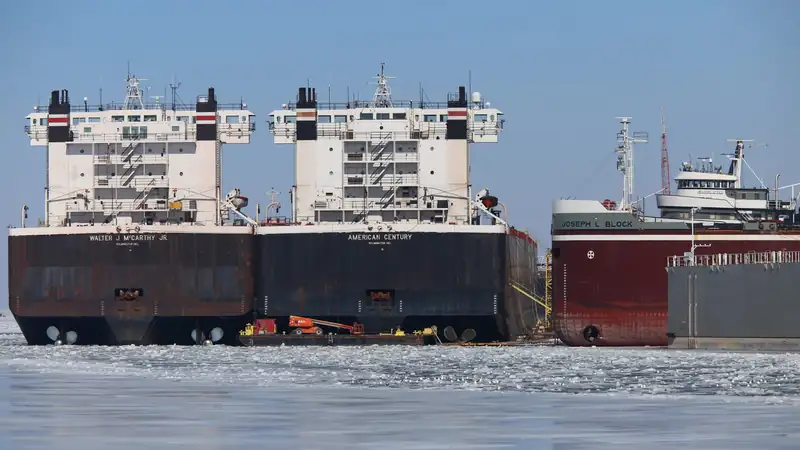
The best-known survivor is Section 27 of the Merchant Marine Act of 1920, universally called the Jones Act. Its rule is short: cargo moving between two U.S. points by water must travel on a vessel that is U.S.-built, U.S.-owned, U.S.-flagged, and crewed predominantly by U.S. citizens. All four conditions at once.
The mechanism that matters is the conjunction. Any single requirement would be a modest constraint. Together they define a small, closed pool of eligible ships, and the size of that pool sets the cost of every domestic ocean move. The Maritime Administration's fleet report for March 2025 counted 188 privately owned, oceangoing U.S.-flag vessels of the relevant class, of which 93 were Jones Act eligible — 56 tankers, 19 containerships, and a scattering of general cargo and roll-on/roll-off ships. That's the entire ocean-going fleet legally available to move goods from Texas to New Jersey, or from Seattle to Anchorage.
Why is the pool small? Because the U.S.-built requirement is expensive. GAO's 2013 examination of Puerto Rico's maritime trade found that foreign-built barges cost roughly 20% less than comparable U.S.-built ones, and foreign-built containerships roughly 50% less. Crewing runs a similar direction: GAO cited Maritime Administration data putting U.S.-flag crewing costs at roughly five times foreign-flag costs on average, with crew running about 20% of vessel operating expense for the Jones Act carriers it examined in 2011.
A law that requires four things at once doesn't add four costs. It multiplies them, because the supply of anything satisfying all four is much smaller than the supply satisfying any one.
Here is where an evenhanded reading matters, because this is one of the most argued-over statutes in American commerce. Supporters describe it as industrial and defense policy: a domestic shipbuilding base, a trained mariner pool, and U.S.-controlled sealift capacity that the Defense Department can call on. Critics describe it as a transfer from shippers and consumers — especially in Alaska, Hawaii, and Puerto Rico, which cannot substitute a truck — to a small maritime sector. Both descriptions are of the same machine.
Case file: the 1886 passenger rule
A quieter sibling explains a travel oddity. Under 46 U.S.C. 55103, originating in an 1886 statute, a vessel that is not coastwise-qualified may not carry passengers between two U.S. ports, directly or by way of a foreign port. Customs and Border Protection's guidance sets the penalty at $300 per passenger so transported, adjusted for inflation, and draws a distinction that does all the practical work: a stop at a "nearby foreign port" — anywhere in North America, Central America, Bermuda, or the West Indies — does not cure a U.S.-to-U.S. passenger voyage, while a "distant foreign port" does.
Case file: the farm bill's fallback
The farm bill is the clearest illustration of features two, three, and four working together, and it's much bigger than agriculture. Congress reauthorizes it roughly every five or six years across a dozen titles — commodities, conservation, trade, nutrition, credit, rural development, research, forestry, energy, horticulture, crop insurance, and miscellaneous.
The money is not where the name suggests. Using the February 2024 Congressional Budget Office baseline for fiscal years 2025 through 2034, the Congressional Research Service put mandatory farm bill outlays at about $1.4 trillion over ten years, of which the nutrition title — chiefly SNAP — accounted for roughly $1.15 trillion, or about 82%. Crop insurance, commodity programs, and conservation together came to under $250 billion. Baselines move with each new projection and each new law, so treat the exact figures as a snapshot and the proportion as the structural fact.
The farm bill is mostly not about farms
Projected mandatory farm bill outlays by title, FY2025-FY2034, February 2024 CBO baseline ($ billions)
That composition is the bundling feature made visible. Nutrition programs and commodity programs have different constituencies; carrying them in one bill gives each a reason to vote for the other. Whatever you think of the result, it's why a farm bill passes at all.
Now the reversion feature, which is where the farm bill gets genuinely unusual. The Agricultural Adjustment Act of 1938 and the Agricultural Act of 1949 never expired. Each modern farm bill suspends them rather than repealing them. If a farm bill lapses without an extension, the suspension lifts and the 1949 rules switch back on — including price supports calculated against a "parity" index anchored to 1910–1914 farm purchasing power. CRS analysis has estimated that reversion would require USDA to support milk at more than $40 per hundredweight against an all-milk farm price around $20, roughly doubling the government's obligation on the first commodity affected.
Almost nobody wants that outcome. It is precisely because nobody wants it that the farm bill is hard to simply let die: the alternative to acting isn't nothing, it's 1949. That's a reversion cliff doing exactly what a reversion cliff does — converting inaction into a threat. The same permanent-law scaffolding is what keeps producing the stranger corners of American agriculture, including the government-adjacent warehouses of surplus cheese.
The sugar program, in miniature
Inside the commodity title sits a program that shows the whole pattern in one commodity. U.S. sugar policy combines non-recourse loans at statutory rates, domestic marketing allotments, and tariff-rate quotas that cap low-duty imports. USDA's Economic Research Service describes the effect plainly: these policies keep U.S. sugar prices above world prices. The loan rates are set in statute — a 2025 budget reconciliation law raised the national average to 24.00 cents per pound for raw cane sugar and 32.77 cents for refined beet sugar, which the Farm Service Agency described as the first meaningful increase in four decades.
Two prices for the same commodity
Nearby futures, calendar-year average, cents per pound: U.S. raw sugar (ICE No. 16) vs. world raw sugar (ICE No. 11)
Source: USDA, Economic Research Service, Sugar and Sweeteners Yearbook Tables (Tables 3b and 4)
The gap is not subtle and it is not new: in every year from 2021 through 2025, the U.S. raw sugar price ran roughly double the world price. Growers and processors argue that world sugar is not a fair benchmark because much of it is produced under foreign subsidy, and that a domestic industry is worth insuring against that. Food manufacturers and confectioners argue that the difference is a cost paid by everyone who buys anything sweetened. Both are describing the same wedge; they disagree about what it buys.
What actually ends a law like this
Since these statutes are durable rather than immortal, it helps to know the four exits.
Sunsets. A provision with an expiration date has to be re-enacted. This is why reauthorization calendars matter more than they sound: they are the scheduled moments when a bundled provision can be unbundled.
Waivers. Many of these laws include administrative escape hatches — the Jones Act allows waivers on national defense grounds, for instance — which relieve pressure case by case without changing the rule. Waivers make a statute more tolerable, which also makes it more durable.
Trade agreements. Tariffs can be lowered by negotiation rather than legislation, which is why some duties fall for particular partners while the general rate stays put.
Litigation. Rules made by agencies interpreting old statutes can be challenged, and the interpretation can move even when the statute doesn't.
Notice what is missing: a floor vote to repeal an unpopular law. That path is available and almost never taken, because the coalition that would have to assemble is exactly the diffuse majority the law's structure prevents from assembling.
Reading the next one
When you meet one of these — a fee, a tariff, a licensing rule, an import cap — four questions get you most of the way to understanding it.
Answer those and you can usually predict how the fight over it will go without taking a side in it. The chicken war ended in the 1960s. Its tariff is in the price of a pickup truck, and it was never really about chicken by the time anyone was paying it.
Primary Sources
- U.S. Government Publishing Office, Proclamation 3564, Increasing Rates of Duty on Specified Articles (Dec. 4, 1963), 77 Stat. 1035
- U.S. International Trade Commission, Harmonized Tariff Schedule of the United States, Chapter 87
- GAO-13-260, Puerto Rico: Characteristics of the Island's Maritime Trade and Potential Effects of Modifying the Jones Act (2013)
- U.S. Maritime Administration, United States-Flag Privately-Owned Merchant Fleet Report (March 2025)
- U.S. Customs and Border Protection, Passenger Vessel Services Act (Informed Compliance Publication)
- Congressional Research Service, What Is the Farm Bill? (RS22131)
Keep explaining: related from the desk
How Ports Work
A container port isn't one system, it's six - paperwork, berth, crane, stack, gate, and the rail or truck that finishes the job. Following a single steel box through all of them explains what ports do to prices and, just as usefully, what they don't.

Why American Cheese Is in Government Caves
There really are limestone caves full of cheese under Missouri - but who owns it, and why it exists at all, is a 50-year story about price floors, a government corporation with a checkbook, and what happens when Washington promises to buy every pound nobody wants.
How a Bill Really Becomes a Law in 2026
The cartoon wasn't wrong - it's just describing a machine Congress rarely uses anymore. How lawmaking actually works now: giant year-end packages, the 60-vote wall, the 51-vote tunnel, and why most successful "bills" never get their own vote at all.