Why American Cheese Is in Government Caves: Ag Policy's Strangest Corners
There really are limestone caves full of cheese under Missouri - but who owns it, and why it exists at all, is a 50-year story about price floors, a government corporation with a checkbook, and what happens when Washington promises to buy every pound nobody wants.
Evergreen explainer, checked against the primary sources listed below. Full disclaimer
On this page5 sections
Every few years the internet rediscovers a delicious fact: beneath Missouri, in cool limestone caverns, sit warehouses holding over a billion pounds of cheese. The fact is real. The usual conclusion drawn from it — that the federal government is hoarding a secret cheddar reserve — is about forty years out of date. But the true story is better, because it explains something bigger than cheese: what happens, mechanically, when the government promises to buy any quantity of a product at a guaranteed price, and why American agriculture is riddled with strange machinery left over from exactly such promises.
Start with the caves, because the caves are real
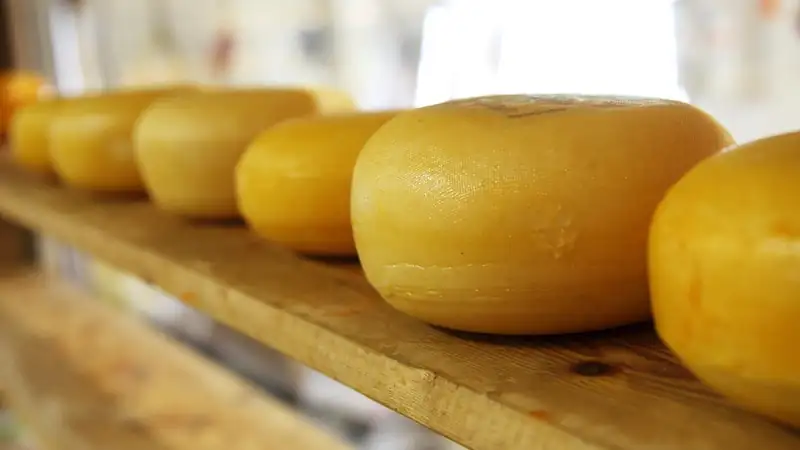
The Kansas City and Springfield areas sit atop thick, easily mined limestone. Decades of quarrying left vast horizontal galleries — and entrepreneurs noticed that a cave holds a steady cool temperature year-round, making it spectacularly cheap to refrigerate compared to an above-ground warehouse. Today those converted mines are ordinary commercial logistics real estate: millions of square feet of climate-controlled storage renting space to food companies. Cheese — which, unlike milk, improves with months of cold aging — is a natural tenant. So yes: there is a staggering amount of cheese under Missouri.
How much cheese, nationally? USDA's National Agricultural Statistics Service counts it every month in its Cold Storage report: about 1.42 billion pounds of natural cheese as of July 31, 2025, alongside roughly 353 million pounds of butter. That's around four pounds of stored cheese per American — which sounds scandalous until you realize it's mostly just the industry's working inventory: cheddar aging toward sharpness, mozzarella staged for pizza chains, stock smoothing the gap between year-round milk production and lumpy demand.
America's dairy in the fridge
U.S. cold-storage stocks, July 31, 2025 — millions of pounds
The machine that buried Washington in cheddar
Since the New Deal, farm policy has run through a peculiar institution: the Commodity Credit Corporation, a government-owned corporation with standing borrowing authority from the Treasury — in effect, a permanent checkbook for intervening in crop markets without annual appropriations. When Congress wants to guarantee farmers a price, the CCC is the machine that does the guaranteeing.
For dairy, the guarantee worked like this: Congress set a support price for milk, and the CCC stood ready to buy unlimited quantities of storable dairy products — cheddar cheese, butter, nonfat dry milk — at prices calculated so that processors could pay farmers the support price and still profit by selling to the government. The government was the buyer of last resort, at a price floor, forever. As long as the floor sat below the market price, the machine idled and cost nothing.
Then Congress raised the floor into the market. Amid the inflation politics of the late 1970s, the support price was hiked 11% in 1978 and another 14% in 1979, climbing from $9.43 per hundredweight of milk in 1977 to $13.10 by 1981, per an Applied Economics Teaching Resources case study of the program. Farmers responded exactly as price theory predicts: they produced more milk — while consumers, facing higher dairy prices, bought less. The wedge between the two had, by law, exactly one place to go.
The floor that rose into the market
Federal milk support price, dollars per hundredweight
Source: Applied Economics Teaching Resources (AAEA), government cheese case study
The numbers turned surreal fast. Between 1977 and 1981 the CCC accumulated some 560 million pounds of cheddar; by 1981 the government was absorbing dairy products at a clip of 20 million pounds a week and spending about $2 billion a year on the program. All of it had to be kept cold somewhere — federal storage contracts filled commercial warehouses across the country, including, yes, the Missouri caves. Reporters started noting that the government's cheese hoard rivaled a pound-per-citizen scale, much of it slowly deteriorating while storage bills mounted. The machine had no off switch: as long as the floor exceeded the market price, every week produced more surplus, bought at taxpayer expense, aging in the dark.
The escape valve: government cheese
Selling the hoard back into the market would crash prices and trigger more support buying — the machine would repurchase its own cheese. Destroying food was politically unthinkable. The remaining exit: give it away to people outside the commercial market. In December 1981, the Reagan administration authorized releasing 30 million pounds of processed surplus cheese to states for distribution to low-income households — the birth of the five-pound block Americans of a certain generation remember simply as government cheese, and of the broader emergency food distribution program (TEFAP) that still supplies food banks today.
Meanwhile Congress spent the 1980s dialing the machine down: support prices were cut, farmers were briefly paid to slaughter dairy herds, and the floor was gradually lowered until government purchases became rare. The formal end came in the 2014 farm bill, which retired the buy-everything price support entirely and replaced it with a subsidized insurance scheme — Dairy Margin Coverage — that pays farmers when the margin between milk prices and feed costs collapses, without the government taking possession of a single pound of product. That design change is the whole reason today's 1.4-billion-pound cheese inventory is private: Washington now writes checks against a formula instead of buying cheddar. (Surplus-purchase authority hasn't vanished — USDA still makes discretionary bulk purchases for food programs in glutted years — but as targeted procurement, not a standing price floor.)
The successor program's design is worth a beat, because it shows what policymakers learned. Dairy Margin Coverage works like subsidized insurance: a farmer enrolls, pays modest premiums scaled to coverage level, and receives payments whenever the national milk-price-minus-feed-cost margin falls below the covered threshold. The government's exposure is now a check, not a cheese; production signals still come from the market; and the program's costs are visible in appropriations rather than accumulating in refrigerated real estate. Layered beneath it, though, still hums one of agriculture's oldest oddities — federal milk marketing orders, a 1930s framework under which USDA referees minimum prices processors pay for raw milk by end use, region by region, through grower referendums. American dairy has never really been a free market; the question each generation re-answers is merely which kind of managed one.
The museum of strange machinery
Government cheese is the famous exhibit, but American ag policy keeps a whole wing of comparable mechanisms — each a rational-seeming lever with memorable side effects, each persisting because its beneficiaries are concentrated and its costs are diffuse. Three quick displays:
The peanut and tobacco quota buyouts. For decades, growing certain crops legally required owning a government-issued quota — an asset families bought, sold, and inherited. Ending the schemes in the 2000s required Congress to purchase the right to farm back from the farmers, in multibillion-dollar buyouts, because the quotas had capitalized into property values. Repealing a subsidy, it turns out, can cost nearly as much as running one.
The sugar program. U.S. sugar prices are held above world levels not by purchases but by supply control: import quotas ration foreign sugar and marketing allotments cap domestic sales, with CCC loans as a backstop. No cheese-mountain optics — the "stockpile" equivalent is simply a higher grocery price, which is why the program is a perennial fight between sugar growers and candy manufacturers.
The raisin reserve. For decades, a New Deal-era marketing order empowered a Raisin Administrative Committee to confiscate a share of every farmer's raisin crop — some years nearly half — to prop up prices. It ended only when a Fresno farmer refused to hand over his raisins and won: in Horne v. Department of Agriculture (2015), the Supreme Court held the scheme an unconstitutional taking of property without just compensation. The government literally argued for, and lost, its right to your raisins.
What the cheese teaches
Strip away the novelty and the cave story is a clean economics lesson wearing a hairnet. A price floor above the market-clearing level doesn't abolish surplus; it purchases it, forever, at public expense — and the surplus then needs somewhere to live (caves), somewhere to go (food banks), and eventually a political exit (program redesign). It's the mirror image of the mechanisms we've traced elsewhere in the food economy: egg prices whipsaw because nobody can store or guarantee eggs, while most grocery prices ratchet upward because their underlying costs are sticky. Dairy in the 1980s was the third configuration: a price nailed in place by statute, with the taxpayer absorbing the difference in forty-pound blocks of cheddar.
The caves, though, were never the strange part. Cool, dry, cheap storage under Missouri is one of the most sensible things in this entire story. The strange part was always above ground, in the fine print of a farm bill — where a support price, a government corporation with a checkbook, and the ordinary logic of supply and demand quietly manufactured a cheese mountain no one ever voted for by name.
Primary Sources
Keep explaining: related from the desk
Why Eggs? America's Most Volatile Grocery Price
Most grocery prices ratchet up and stay. Egg prices rocket, crash, and rocket again. The reason is biology meeting industrial structure — a supply chain where one virus in one barn can erase millions of layers overnight, and rebuilding takes months.
Why Grocery Prices Don't Come Back Down
Inflation cooling doesn't mean prices fall — it means they climb slower. Here's the machinery that makes grocery prices a one-way ratchet, from sticky wages to the 11.8-cent farm share.
Daylight Saving Time: Why It's So Hard to Kill
Twice a year America argues about the clocks, and nothing changes. The machinery behind that stalemate — a 1966 federal law, a lopsided opt-out rule, an energy rationale that mostly evaporated, and the one time we tried permanence and hated it.