The 911 System: What Happens in the 10 Minutes After You Call
Three digits, 216 million calls a year, and a machine assembled from phone-bill fees, county call centers, and a routing system originally built for landlines. What actually happens between your dial and the sirens - and why your phone's location is the hard part.
Evergreen explainer, checked against the primary sources listed below. Full disclaimer
On this page4 sections
The first 911 call in American history was placed on February 16, 1968, in Haleyville, Alabama — a ceremonial call from a state legislator, answered on a bright red phone at the police station. It worked because the local phone company had wired three digits to ring one desk. Fifty-plus years later, the country still runs on the same elegant premise — any phone, three digits, help comes — except the phone is now a computer moving at highway speed, the "desk" is one of thousands of independent local call centers, and the wiring in between is a machine almost nobody has mapped end to end.
Here's the map of the whole apparatus: what actually happens in the seconds and minutes after you dial, who's actually on the other end, how the system finds you (usually), and who pays for all of it (you, via a line item on your phone bill you've probably never read).
Minute zero: the routing decision
Dial 911 and your call's first stop isn't a call center — it's your carrier's network, which must answer a deceptively hard question in about a second: which 911 center gets this call? There is no national 911 office. The FCC's latest annual survey counts 4,628 primary PSAPs — public safety answering points, the industry term for 911 call centers — plus 567 secondary ones, operated overwhelmingly by counties, cities, and regional authorities. Each covers a defined patch of map. Your call must land on the right patch.
For a landline, that's a database lookup: the address is known and pre-matched to a PSAP. For the 76.4% of calls that now come from wireless phones (165 million of 2023's 216 million voice calls, per the FCC), the legacy method routes by which cell tower sector picked you up — a decent proxy that fails at the margins, which is why calls placed near county lines or on highways sometimes reach a neighboring jurisdiction's center and must be transferred, burning seconds. The modernization program called Next Generation 911 (NG911) — an internet-protocol rebuild of the whole pipe, rolling out state by state under plans documented by the Congressional Research Service — replaces tower-guessing with location-based routing, and while it's at it, adds the ability to carry texts, photos, and video into a system originally engineered for analog voice. (Text-to-911 already works in much of the country: 3,633 PSAPs could receive texts by the end of 2023, handling about 1.2 million of them that year.)
Minutes one and two: the interrogation is the dispatch
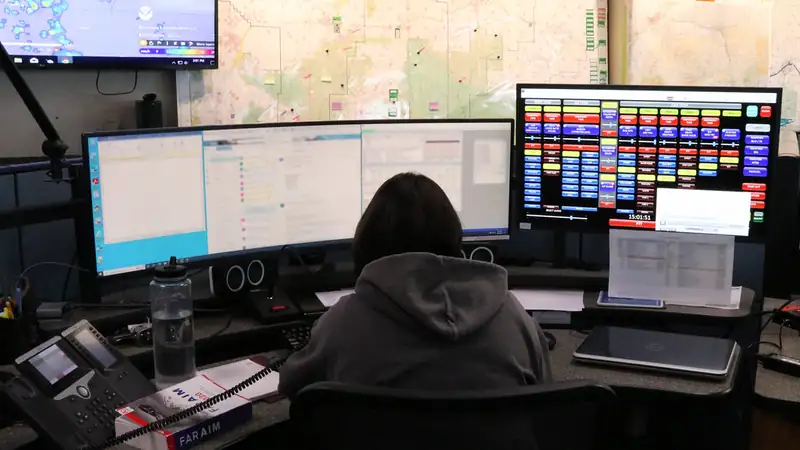
A telecommunicator answers — one of roughly 40,000 full-time 911 professionals nationally, per the FCC's fee-report data. What happens next looks, to a stressed caller, like bureaucratic stalling: Where is your emergency? What's the address? Say it again? It isn't stalling; it's the system's single most important verification step, because the address on the screen may be a tower estimate, and because the call can drop at any moment. Location first, callback number second, nature of emergency third — that triage order is drilled into every trainee.
Then the fork: police, fire, or medical. At many centers the call-taker types the incident into a computer-aided dispatch (CAD) system while a separate dispatcher — sometimes at a secondary PSAP — assigns units by location and availability; at smaller centers one person does both jobs, often for multiple agencies at once. For medical calls, many centers run scripted emergency medical dispatch protocols: structured questions that both grade the response (lights-and-sirens or routine) and turn the telecommunicator into a first responder — coaching CPR, childbirth, or bleeding control by phone during the gap before units arrive. The dispatch itself typically goes out within the first minute or two; the interrogation and the response run in parallel, not in sequence, which is the detail callers most often misunderstand.
The ten minutes, minute by minute
A typical urban wireless 911 call, from dial to arrival
Diagram: The Explainer Desk. Source: FCC 911 program materials; CRS NG911 report. CRS R45253
The hard problem: where you are
The system's defining struggle for two decades has been the gap between what callers assume ("they know where I am — it's a phone") and physics. A rideshare app can hover a pin on your doorstep because you granted it your phone's fused GPS-and-WiFi location; legacy 911 infrastructure, by contrast, received a tower-sector estimate that could span blocks. Federal rules have ratcheted the requirements: carriers must deliver increasingly precise coordinates (FCC "Phase II" rules), modern handsets now push device-based hybrid location — the same GPS/WiFi fusion the apps use — directly to 911 through smartphone operating systems, and newer mandates add the vertical axis, because a latitude-longitude fix on a 40-story building still leaves 39 wrong floors. Two federal laws round out the picture: Kari's Law (direct 911 dialing from hotel and office phone systems, no "9" prefix — named for a woman whose daughter couldn't reach help) and the RAY BAUM'S Act requirement that multi-line systems transmit a "dispatchable location," meaning room and floor, not just a street address.
Two consumer-facing corollaries fall out of the location machinery. First, the reassuring one: an old phone with no service plan can still call 911 — federal rules require carriers to complete emergency calls from any capable device, which is why charities refurbish phones for domestic-violence shelters. Second, the cautionary one: calling 911 does not turn your phone into a tracking beacon for authorities at large. The enhanced-location pipeline activates for the emergency call itself; broader law-enforcement location requests travel an entirely separate legal channel with warrant requirements — two systems the public routinely conflates in both directions, fearing surveillance from the one built to save them and assuming rescue capability from the one built for evidence.
Who pays, and the fee that wanders off
Now the money, which explains more of the system's unevenness than any technical fact. That "911 fee" line on your phone bill — typically a dollar or so per line per month, set by each state — is the system's primary funding. Per the FCC's Sixteenth Annual Report to Congress, jurisdictions collected about $4.03 billion in 911 fees in calendar 2023. The same report documents the practice that gives the FCC an annual occasion for polite fury: fee diversion — states spending 911 money on non-911 purposes — totaling about $215.7 million (5.35%) in 2023, concentrated in a handful of repeat-offender states that Congress and the FCC now name publicly.
America's 911 traffic, by the FCC's count
Calendar year 2023 — millions
Source: FCC, Sixteenth Annual Report to Congress on 911 Fees (2024)
The phone-bill fee, and where some of it goes
911 fees collected vs. diverted to other purposes, 2023 — $ billions
Source: FCC, Sixteenth Annual Report to Congress on 911 Fees (2024)
Because funding and governance are local, so is performance: a metro center with hundreds of staff, NG911 links, and text capability shares the three digits with a two-console rural PSAP dispatching volunteers across a mountain county — one reason response times vary far more by geography than any national average suggests, and why the NG911 transition (like rural broadband, its infrastructure cousin) advances county by county rather than by national switch-flip. The workforce underneath it all is chronically strained — understaffing and 12-hour shifts are the industry's standing crisis, and a long-running push seeks to reclassify telecommunicators federally as a protective-service occupation rather than clerical staff, a change advocates argue matches the CPR-coaching reality of the job.
The forward-looking pieces are already visible in county budget requests. NG911's multimedia capability means the crash-detection alert from a phone or car can someday arrive carrying coordinates, impact data, and occupant count before anyone speaks; PSAPs are beginning to receive telematics feeds from vehicles today. Real-time text and video promise access for deaf and hard-of-hearing callers beyond the current TTY-era accommodations. And the parallel launch of 988 — the three-digit suicide and crisis lifeline — represents a deliberate unbundling: routing behavioral-health crises toward counselors and, where they exist, mobile crisis teams instead of the police-fire-EMS trio, a rewiring of the front door that jurisdictions are implementing at very different speeds. Each of these is, at bottom, the same question the red phone in Haleyville answered in 1968: when something goes wrong, exactly which humans should the network summon, and how fast can it tell them where?
The machine's quiet marvel is the same as the payment network's: radical decentralization behind a single, universal interface. Thousands of independent centers, fifty funding schemes, two generations of technology mid-transition — and from the outside, just three digits that have meant the same thing since a red phone rang in Alabama in 1968. When the next upgrade argument reaches your county commission — NG911 money, staffing, that diverted fee — you'll know exactly which part of the ten minutes it touches — and which minute your county is actually voting on.
Primary Sources
Keep explaining: related from the desk
How Weather Forecasts Are Made
Twice a day, at the same synchronized moment worldwide, hundreds of balloons rise into the sky so a supercomputer can solve physics equations about tomorrow. The full pipeline behind your weather app - and why the ten-day forecast will always wobble.
Why Your Internet Bill Is What It Is
The internet's backbone is fiercely competitive and absurdly cheap. The wire to your house is neither. How the economics of the "last mile" decide what you pay, why a third of Americans have one real choice or none, and what $42 billion is trying to change.
How Payments Move in the 3 Seconds After You Tap
Between the tap and the beep, your transaction crosses at least four companies, gets scored for fraud, and comes back approved - while the actual money doesn't move for a day or more. The authorization machine, the chip's cryptographic trick, and who pays whom.