The Chip in Your Card: How Payments Move in the 3 Seconds After You Tap
Between the tap and the beep, your transaction crosses at least four companies, gets scored for fraud, and comes back approved - while the actual money doesn't move for a day or more. The authorization machine, the chip's cryptographic trick, and who pays whom.
Evergreen explainer, checked against the primary sources listed below. Full disclaimer
On this page6 sections
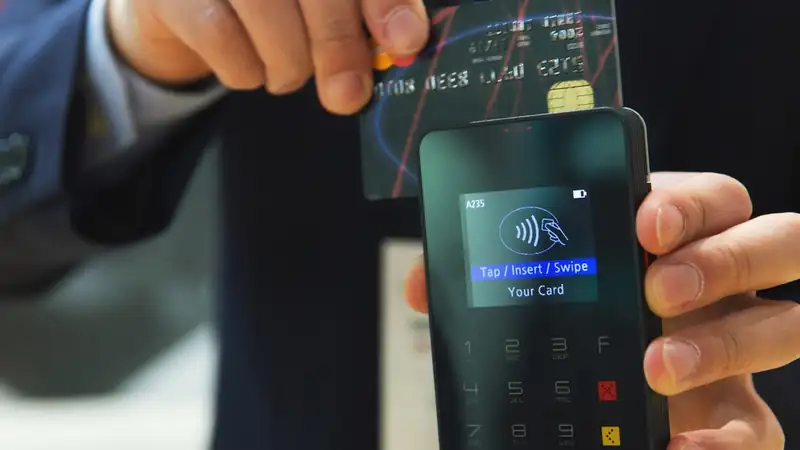
You tap. Something beeps. A screen thanks you, possibly after asking about a tip. Total elapsed time: two or three seconds — during which your transaction has traveled to your bank and back through at least four intermediaries, been cryptographically vouched for by a computer inside your card, and been scored against a fraud model that made its decision in milliseconds.
Americans run this machine constantly — noncash payments hit 236.6 billion transactions in 2024, per the Federal Reserve's triennial payments study, with cards making up over three-quarters of them by count. Almost nobody can say what happens inside the beep. Here's the whole circuit: the players, the chip's actual trick, where the money moves (spoiler: later), and the fee machinery underneath that quietly shapes prices, rewards programs, and a decade of lobbying wars.
The cast of characters
Every ordinary card payment involves four parties besides you, and the jargon is simpler than it sounds:
- The merchant, who wants to get paid.
- The acquirer — the merchant's payment bank/processor, which operates the terminal connection and fronts the plumbing.
- The network — Visa, Mastercard, and peers — which owns no money in the transaction; it's a messaging-and-rules layer connecting thousands of banks that have never met.
- The issuer — the bank that gave you the card, holds your account, and takes the credit risk. The issuer is the only party actually deciding whether you can spend.
Keep the division of labor straight and the rest follows: the network is a switchboard with a rulebook; the issuer says yes or no.
Seconds 0 to 3: the authorization round trip
When you tap or dip, the terminal packages a request — card credentials, amount, merchant identity — and fires it to the acquirer, which routes it to the network, which routes it to your issuer. The issuer's computers run the real gauntlet: Is the account open, with headroom? Does the cryptography check out? And — in the milliseconds that matter most — does a fraud model like this purchase? The model scores the transaction against your history (location, merchant type, amount, velocity of recent charges), which is why a gas station 400 miles from home sometimes triggers a decline while a $900 online order sails through. An approval code retraces the whole path back to the beep.
The three-second round trip (and the slow lane underneath)
Authorization happens live; the money settles later in batches
Diagram: The Explainer Desk. Source: Federal Reserve payments system materials. Federal Reserve Payments Study
What the chip actually does
The magnetic stripe — now nearly retired — stored your card number as static data: skim it once and a fraudster could stamp out working clones. The EMV chip (the standard's name comes from Europay, Mastercard, and Visa) is a tiny computer that plays a different game: for every transaction it generates a one-time cryptogram from a secret key that never leaves the chip, signing over the transaction details. Intercepting one cryptogram gets a thief nothing; it's already spent. Cloning the card requires extracting a key the hardware is engineered not to reveal.
The U.S. adopted chips a decade after Europe, forced by an October 2015 liability shift: the networks decreed that whichever party hadn't upgraded — merchant without a chip terminal, issuer without chip cards — would eat counterfeit-fraud losses. Fraud economics did the rest. Per Visa's own data, counterfeit fraud dollars at chip-enabled U.S. merchants fell 76% from September 2015 to December 2018. Tap-to-pay is the same cryptography over a radio link (NFC), and phone wallets add tokenization: your phone stores a substitute card number useless outside that device, so a breached merchant database leaks tokens, not cards. The predictable footnote: as card-present fraud collapsed, fraud migrated online — card-not-present fraud, where no chip can vouch for anything, is where the arms race now lives, fought with the same behavioral scoring that decides your three seconds.
Follow the money: interchange, the invisible toll
Now stage two, where the funds actually move — minus a toll. When the merchant's batch clears and settles a day or two later, the merchant doesn't receive 100 cents on the dollar. A percentage-plus-pennies interchange fee, set by the network's published schedules, is deducted and lands with your card's issuer; the network and acquirer take smaller slices. On credit cards, interchange commonly runs around 2% (higher for premium rewards cards) — and that revenue is precisely what funds cash-back and miles. A rewards card is, mechanically, a machine for routing a slice of every merchant's revenue back to cardholders, with the issuer keeping the difference; whether that arrangement effectively raises retail prices for everyone, including cash payers, is a long-running empirical and political fight (merchants and some economists say yes; networks dispute the size), fought through lawsuits, surcharging rules, and periodic "swipe fee" legislation. This desk just notes the pipe exists and who's standing at each end.
Congress has intervened once, on the debit side. The 2010 Durbin Amendment ordered the Fed to cap debit interchange for banks over $10 billion in assets; the Fed's Regulation II set the cap at $0.21 plus 0.05% of the transaction, plus a penny for fraud prevention. The Fed's own data shows the cap binding hard in 2024: covered banks' debit interchange averaged $0.23 per transaction (0.47% of value) versus $0.51 (1.21%) for exempt smaller banks.
What a debit swipe earns the bank, capped vs. not
Average debit interchange per transaction, 2024
Source: Federal Reserve, Regulation II average interchange fee data (2024)
The same amendment planted a second, stranger lever: routing rights. Every debit card must be enabled on at least two unaffiliated networks, and the merchant — not the bank — chooses which one carries the transaction, a rule the Fed extended explicitly to online debit in 2022. That's why a debit transaction may travel a network whose logo appears nowhere on your card, and why "debit or credit?" at a terminal is often really a routing question in disguise, worth real money to the merchant either way.
That one rule explains a decade of product design: debit rewards programs died after 2011 (the toll that funded them was capped), while credit rewards flourished (uncapped) — and it's why your bank would much rather you run that transaction "as credit."
When the promise breaks: chargebacks
The system in one glance
So, the full three seconds, honestly labeled. The chip vouches that the card is present and genuine. The issuer vouches that you're good for it, consulting both your balance and a risk model built from your own behavior (the same data economy that feeds your credit file). The network carries messages and sets the tolls; the acquirer aggregates the merchant's side; and the money itself ambles through a day-later batch settlement while everyone acts as if it already moved — the whole edifice resting on netted bank obligations and a rulebook for when promises break (that's what a chargeback is: the rulebook running in reverse).
Where is this machine heading? Two pressures are visible without any forecasting. Real-time settlement rails now exist — the Fed's own instant-payment service among them — moving money in seconds rather than batches, and merchants would dearly love rails that skip interchange entirely; pay-by-bank schemes keep probing for consumer adoption against the incumbent's twin moats of habit and rewards. And the legal architecture around interchange remains actively contested — merchant litigation and proposed routing legislation resurface every congressional term. The three-second experience will likely outlive any particular plumbing beneath it; the fee schedule is where the fighting is.
It's worth a moment's genuine admiration: a machine that lets any stranger's plastic obligate any bank on the continent, in three seconds, hundreds of millions of times a day — held together not by any single ledger but by cryptography, batch files, and fee schedules. The beep is the sound of four institutions agreeing to trust each other later.
Primary Sources
Keep explaining: related from the desk
How Credit Bureaus Got to Know Everything About You
You never signed up, but three companies keep detailed files on your financial life. Here's the system — furnishers, the FCRA, scoring models — that decided your data would be collected by default, and the rights wired in as the price.

Why Tipping Took Over America
A brief history of an imported custom America once tried to ban — and the 1966 legal invention, the tip credit, that hard-wired tipping into restaurant economics and now follows you to every checkout screen.
How Amazon Delivery Actually Works
The box on your porch is the last step of a machine built from eight regional networks, robotic warehouses, a private trucking layer, and thousands of small delivery companies wearing Amazon's colors. Here's the whole run, from stow to doorstep.